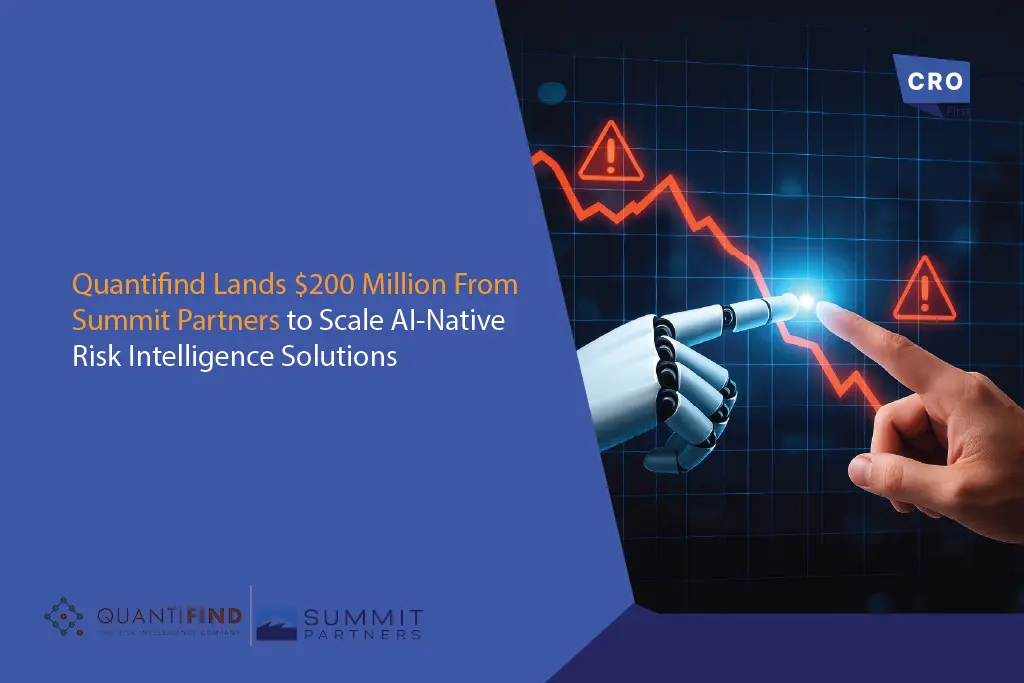
Quantifind, a major provider of AI-native Risk Intelligence solutions for contemporary financial crime and national security-related activities, has made public a growth investment of $200 million. Summit Partners led the investment round, supplemented by contributions from long-standing institutional investors like Citi Ventures, S&P Global, Deloitte, and Stephens Group. Part of the funding will be geared towards opening new offices and growing the operation in the regions of Europe, Asia-Pacific and the Americas, Apart from further investing in the deployment of the company’s main risk intelligence ecosystem and newly released agentic workflow solutions.
Financial crime groups are using more complex methods, working at a higher pace and on a global scale. Legacy risk systems are only just beginning to understand how to stay in step with these transformations. Traditional Anti-Money Laundering (AML), Know Your Customer (KYC), and sanctions screening systems have been severely limited by the use of fragmented data and rule-based logic that is inflexible. This kind of simple technology is double-edged as it produces a lot of false-positive alerts which then have to be sifted through manually by employees, thereby adding to the everyday burden, slowing down the most important investigations, and making life Mainly hard for those that are legitimate users of the financial system. Quantifind does away with this waste of resources by linking internal and external data sources through specially designed language models that do the manual work of entity resolution and risk discovery.
Transitioning AI Assistants Into Trusted Compliance Operators
The strategic capital arrives alongside the launch of the company’s Graphyte Agentic Middleware, a specialized orchestration layer designed to transform how regulated institutions handle automated risk operations. While general-purpose language models function primarily as passive co-pilots or chat assistants, Quantifind’s new framework provides the enterprise-grade controls, auditable data grounding, and governance required to allow autonomous agents to execute complex, high-stakes compliance workflows.
Also Read: Luma Financial Technologies Expands Wealth Management Capabilities Through Parnership with TD Securities
The system addresses critical operational and structural challenges across the enterprise risk lifecycle:
- True Entity Resolution: Combines public web data, corporate registries, and internal customer ledgers to isolate true risk entities from common naming variants and false matches.
- Governed Agentic Execution: Orchestrates autonomous AI agents to perform deep background investigations and generate comprehensive reports while strictly maintaining regulatory compliance.
- Explainable Risk Discovery: Replaces opaque machine-learning outputs with fully auditable, step-by-step risk justifications, giving human compliance officers full transparency into automated conclusions.
- Elimination of Alert Overload: Slashes false-positive alert volumes to free up specialized internal resources, allowing risk teams to focus exclusively on highly credible threats.
Quantifying the Economic Impact on Tier 1 Compliance
The commercial viability of the platform is substantiated by independent industry data. According to an economic analysis conducted by research firm Celent, Tier 1 banking institutions deploying Quantifind’s Graphyte platform across their KYC and sanctions screening workflows could achieve massive cost reductions. By minimizing manual review times and accelerating case resolution via high-confidence automation, a single Tier 1 bank can reduce its annual alert-processing overhead by up to $177.9 million.
This financial and operational efficiency has driven widespread adoption across the global financial sector. Quantifind’s platform currently supports tens of thousands of compliance, risk, and national security professionals, counting six of the world’s top ten Tier 1 financial institutions as active customers.
Executive and Investor Perspectives on Governed Risk Automation
“Modern financial crime operations require accuracy, speed, scale, and explainability simultaneously – there is no acceptable tradeoff among them in regulated environments,” said Ari Tuchman, CEO and co-founder of Quantifind. “As AI transforms risk operations, success will depend on governed AI systems grounded in trusted intelligence and human oversight.”
“Quantifind has established itself as a leader in AI-native Risk Intelligence,” said Chris Dean, Managing Director at Summit Partners, who has joined the company’s board of directors. “The Quantifind platform is designed to combine high-precision intelligence, explainability, and enterprise-grade scalability to help financial institutions detect and prevent financial crime with precision and speed. We are excited to partner with Ari and the team as they work to extend their global reach and continue advancing trusted AI infrastructure.”
Global Expansion Roadmap and Market Integration
With the closing of this growth round, Quantifind plans to aggressively expand its footprint across multinational markets. The corporate expansion strategy focuses heavily on deep regional partnership development, strict local regulatory alignment, and the deployment of localized risk typologies to simplify cross-border risk management for global financial institutions.
The Graphyte platform and its accompanying agentic middleware features are active and available immediately for integration within existing corporate banking stacks. Risk operations executives, financial crime directors, and compliance leaders can review system architecture specifications, evaluate economic impact studies, and coordinate technical platform demonstrations by visiting the risk hub.