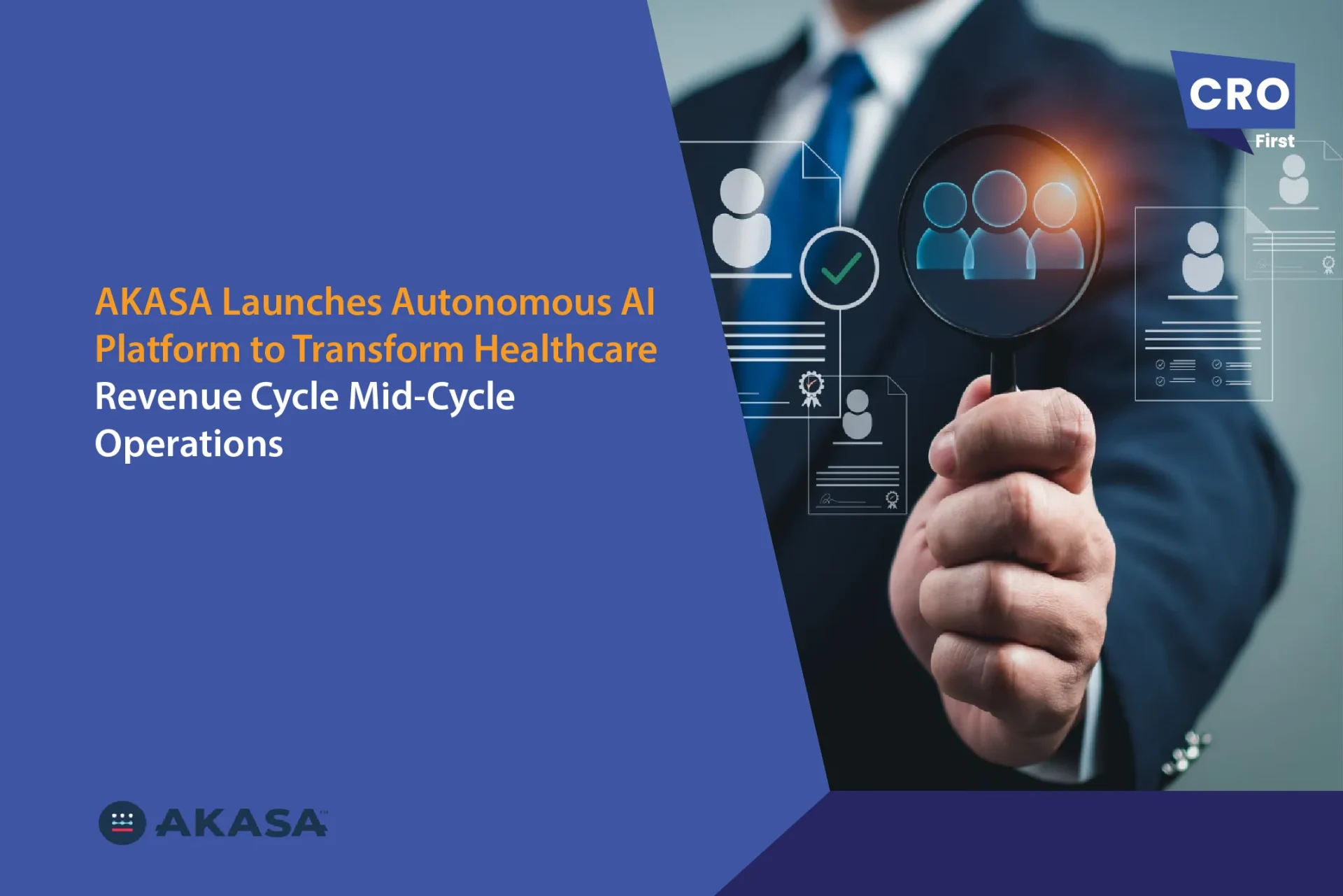
Healthcare generative AI provider AKASA has officially launched an autonomous AI platform engineered specifically for mid-cycle revenue operations, expanding its solution suite beyond prebill review into autonomous processing for inpatient medical coding and clinical documentation integrity (CDI).
This growth is the result of AKASA’s fast rate of adoption among health system clients in its network, as healthcare systems seek to use generative AI tools to much lower workflow burden in their revenue cycle processes. In the last year alone, AKASA’s inpatient volume has increased nearly 6X. Currently, AKASA supports health systems representing over $180 billion of combined net patient revenue and roughly 10% of U.S. inpatient discharges.
AKASA adapts its models to each health system to lessen variation in operations among health networks. Our customized approach weaves in regional population demographics, clinical parameters, documentation practices, and extension of care delivery complexity to foster comprehensive clinical documentation and coding.
Bringing Autonomous AI to Complex Revenue Operations
The healthcare mid-cycle serves as the critical junction where raw patient records are translated into standardized medical codes that govern reimbursement, quality reporting, risk adjustment, and clinical record integrity. Historically, this work has remained highly complex, labor-intensive, and prone to administrative bottlenecks.
Industry data underscores these persistent operational challenges. A 2025 peer-reviewed study in npj Health Systems cited medical coding error rates as high as 20%, while a July 2026 report from the U.S. Government Accountability Office (GAO) identified verifiable accuracy as a central obstacle facing health systems adopting AI for clinical documentation.
Also Read: ZoomInfo Expands Workflow Integration With Superhuman Go Connector for GTM Intelligence
AKASA’s autonomous technology addresses these failure points by fully coding complex inpatient cases across all specialties without human intervention. The company plans to expand the platform to support outpatient facility encounters in an upcoming release.
Key performance and operational milestones delivered by the platform include:
Proven Clinical Accuracy: Independent, blinded evaluation studies comparing AKASA’s AI against human medical coders across 65%–85% of health system inpatient volume demonstrated that the AI matched or exceeded human performance on key quality metrics, including MS-DRG assignment, principal diagnosis, clinical quality capture, and present-on-admission accuracy.
Drastic Processing Velocity: While human coders typically require 30 to 60 minutes per inpatient encounter often compounded by multi-day backlog delays AKASA’s AI completes coding within 90 seconds of patient discharge, significantly reducing accounts receivable (A/R) days.
Unified Mid-Cycle Architecture: Integrates clinical documentation integrity (CDI) upstream with medical coding and prebill review into a single, cohesive AI operational layer.
Flexible Enterprise Deployment: AKASA collaborates with individual health systems to design tailored rollout strategies that scale autonomous processing volume based on specific operational priorities.
“The incredible demand for healthcare is finally being addressed by advancements in AI. Multiple parts of the healthcare ecosystem will need to scale up, with documentation and coding being critical components,” said Malinka Walaliyadde, CEO and co-founder of AKASA. “For years, an autonomous mid-cycle has been a holy grail in our industry. Today, AKASA is making it real.”
“Our revenue cycle work is especially time-intensive because we care for many medically complex patients,” said Rohit Chandra, Ph.D., chief digital officer at Cleveland Clinic. “With autonomous coding, we seek to improve speed and precision in these challenging processes under a compliance-first approach to this work.”
“AKASA has been a pioneer in generative AI and in revenue cycle solutions,” said Jeff Francis, chief financial officer and vice president of finance at Nebraska Methodist Health System, who has worked with the company for several years. “We’ve moved with them step by step, and it shows up in the metrics I care about: revenue integrity, denials, write-offs, and how quickly we get paid. Autonomy feels like the natural next step as health systems look for ways to increase capacity and make complex revenue cycle tasks more efficient.”
“Healthcare cannot meet the scale of demand ahead through human labor alone,” said Julie Yoo, general partner at Andreessen Horowitz (a16z). “AKASA is turning deep technical research into frontier AI that can do complex work at scale inside the country’s most sophisticated health systems. Its autonomous mid-cycle technology shows what’s possible when AI is built for the specific demands of complex clinical documentation and inpatient coding.”
Modernizing Enterprise Revenue Infrastructure
By pairing domain-specific generative AI with rigorous accuracy standards, AKASA provides health systems with a scalable framework to expand workforce capacity, accelerate billing cycles, and maintain compliance across complex clinical documentation workflows.