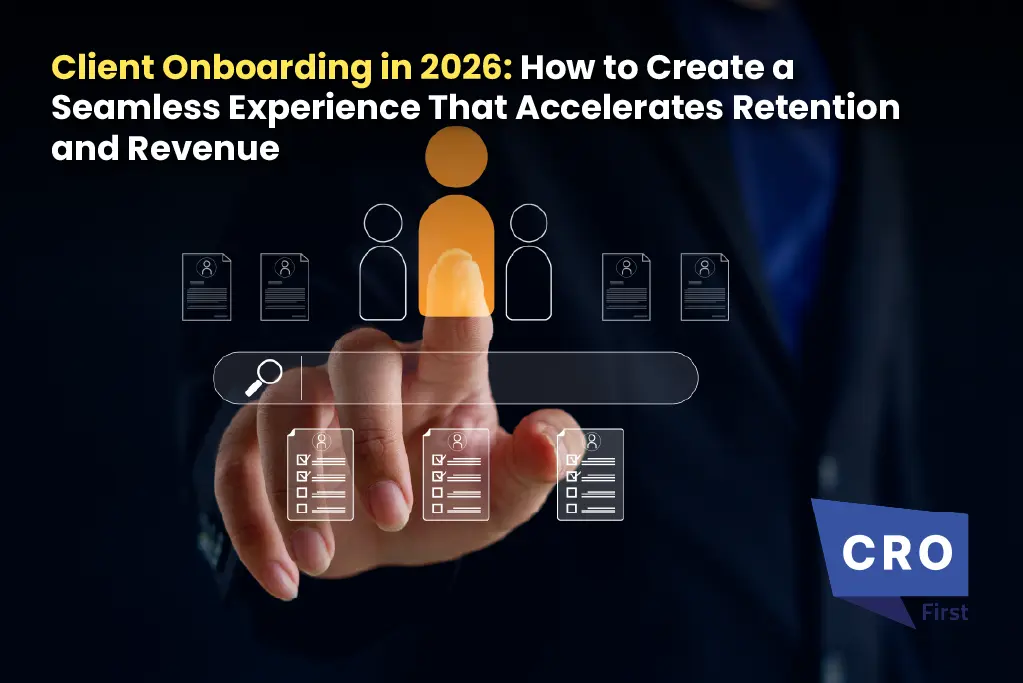
Most companies still think client onboarding starts after the contract gets signed.
Wrong starting point.
Client onboarding actually starts the moment a buyer asks themselves a dangerous question:
‘Did we make the right decision?’
That small window between purchase and first success decides whether a customer becomes long-term revenue or silent churn. And in 2026, that pressure is even higher because customer expectations are no longer basic. According to Adobe’s 2026 AI and Digital Trends report, customers now expect experiences that are highly personalized and anticipatory (80%), seamless across physical and digital touchpoints (72%), and AI-powered while still feeling human and brand-aligned (60%).
That changes the game completely.
Client onboarding is no longer a setup process. It is your first retention system, your first trust-building exercise, and honestly, your first real revenue opportunity. This article breaks down how modern onboarding works in 2026, what businesses keep getting wrong, and how to build an onboarding process that reduces friction, speeds up Time-to-Value, and strengthens customer retention from day one.
Why Client Onboarding Became a Revenue Engine
Most onboarding processes fail because companies treat them like administration.
Forms. Access. Welcome emails. Training PDFs nobody reads.
Meanwhile, the customer is sitting there trying to figure out one thing:
‘When do we actually start seeing value?’
That is why Time-to-Value matters more than almost every other onboarding metric today. The faster a client sees a meaningful outcome, the faster trust compounds. And once trust compounds, expansion revenue becomes easier.
This is where many businesses still miss the bigger picture. Retention does not start six months later. It starts during onboarding.
A slow onboarding experience creates:
- buyer’s remorse
- internal frustration
- poor adoption
- weak stakeholder confidence
- delayed ROI conversations
On the other hand, a strong client onboarding process creates momentum early. Teams align faster. Decision-makers feel validated. Users engage more confidently. As a result, the relationship shifts from ‘vendor’ to ‘strategic partner.’
Salesforce says 85% of service leaders now expect their organizations to contribute more revenue this year. At the same time, 88% of customers say the experience matters as much as the product or service itself.
That stat explains the entire shift.
Products can still be copied. Pricing can still be undercut. Features eventually become commodities. Experience does not.
Good onboarding reduces friction. Great onboarding creates emotional certainty. And emotional certainty is what keeps customers renewing, expanding, and referring others.
That is why client onboarding is no longer sitting inside support teams quietly. It is becoming a revenue conversation.
The 5-Step Client Onboarding Framework for 2026
Most onboarding breakdowns happen because companies focus too much on tasks and not enough on transition psychology.
The client is not only learning your system. They are learning whether your company is reliable under pressure.
That difference matters.
Step 1: Fix the Sales-to-Success Handoff
Nothing kills onboarding momentum faster than making clients repeat themselves.
Yet companies do this constantly.
The sales team closes the deal. Then customer success jumps in with:
‘Can you explain your goals again?’
‘Who are the stakeholders?’
‘What problems are you solving?’
That instantly damages confidence.
A proper client onboarding process needs an internal transition brief before kickoff even happens. That brief should include:
- business objectives
- expected outcomes
- implementation scope
- timelines
- stakeholder structure
- promised deliverables
- risk areas
The customer should feel continuity, not departmental disconnect.
Because from the client’s perspective, there is only one company. Not five internal teams.
Step 2: Run a Strategic Kickoff Call
Most kickoff calls are too operational.
They focus on timelines and tools while ignoring alignment.
Big mistake.
The kickoff call should establish:
- what success looks like
- who owns what
- communication cadence
- escalation process
- realistic timelines
- adoption expectations
This is also the stage where smart companies set boundaries early. Otherwise, onboarding slowly turns into unmanaged chaos.
Clients actually trust companies more when expectations are clear. Ambiguity creates anxiety. Structure creates confidence.
A good kickoff call also uncovers hidden friction early:
- conflicting stakeholder priorities
- unrealistic expectations
- missing technical readiness
- weak internal buy-in
Solving these problems early prevents future churn conversations.
Step 3: Deliver a Quick Win Fast
This is where most onboarding strategies collapse.
Companies spend months ‘implementing’ while customers see nothing meaningful.
Momentum dies quietly.
A modern client onboarding strategy needs one visible win within the first 14 to 30 days.
Not perfection. Progress.
That quick win could be:
- a successful integration
- improved reporting visibility
- faster workflows
- reduced manual work
- early adoption milestones
- measurable time savings
The goal is psychological validation.
Customers need proof that their purchase decision was smart. Especially decision-makers who internally pushed for the investment.
Quick wins reduce buyer anxiety. They also create internal champions faster because teams start seeing actual movement instead of endless onboarding meetings.
Also Read: Customer Success Hiring Guide 2026: How to Build High-Performing Retention and Growth Teams
Step 4: Move from Setup to Adoption
This is the phase where onboarding becomes real.
Many companies stop too early. They think setup equals success.
It does not.
A customer that purchased your platform but never fully adopted it is basically future churn waiting quietly in the background.
That is why routine check-ins matter. Not robotic status meetings. Actual enablement.
Strong onboarding teams continuously:
- monitor adoption gaps
- answer friction points
- train users
- simplify workflows
- reinforce business outcomes
IBM says AI can now handle repetitive onboarding tasks consistently while machine learning can identify where customers get stuck so businesses can resolve onboarding bottlenecks faster.
That matters because onboarding friction usually hides in small moments:
- confusing workflows
- delayed approvals
- unclear next steps
- overwhelmed users
- lack of confidence
The faster companies identify these gaps; the faster adoption improves.
And adoption is what drives retention.
Step 5: Transition into Long-Term Customer Success
One of the biggest onboarding mistakes is disappearing too suddenly.
Clients should never feel abandoned after implementation.
A proper post-onboarding transition should include:
- success recap
- KPI review
- ownership transition
- long-term roadmap
- future optimization goals
- support structure clarity
This stage matters because onboarding is not the finish line anymore. It is the foundation for expansion.
The first 90 days often decide:
- renewal probability
- upsell potential
- product adoption depth
- advocacy likelihood
Companies that treat onboarding as a short-term checklist usually create transactional relationships. Companies that treat onboarding as a growth phase build long-term accounts.
Big difference.
Low-Touch vs High-Touch Client Onboarding
Not every customer needs the same onboarding model.
Trying to give enterprise onboarding to every SMB client becomes expensive fast. At the same time, giving enterprise customers a fully automated experience usually backfires.
The smarter approach in 2026 is hybrid onboarding.
Low-Touch or Tech-Touch Onboarding
Best for:
- SMBs
- self-serve customers
- lower ACV accounts
This model usually includes:
- automated onboarding emails
- in-app walkthroughs
- onboarding checklists
- video tutorials
- knowledge bases
- automated milestone reminders
It scales well. It also reduces operational pressure.
High-Touch Onboarding
Best for:
- enterprise accounts
- complex implementations
- multi-stakeholder environments
This model includes:
- dedicated Customer Success Managers
- tailored onboarding plans
- live workshops
- executive alignment calls
- QBRs
- adoption reviews
One senior Customer Success leader recently described the shift perfectly:
‘2026 onboarding is no longer low-touch versus high-touch. The strongest companies are blending automation with human guidance at the exact moments customers need reassurance.’
That is the real shift happening now.
Automation handles speed. Humans handle trust.
Technology and AI in Client Onboarding

AI is helping onboarding teams move faster. But speed without clarity still creates bad experiences.
That is where many companies are getting exposed.
HubSpot’s 2026 marketing report says 92% of marketers now use automation for data analysis and reporting, while 40% say their customer journeys are mostly or fully automated.
So automation is clearly becoming standard.
But automation alone is not the answer.
PwC’s 2026 operations survey says 89% of operations leaders believe their technology investments have not fully delivered expected results, while 87% say poor data quality has limited value from digital initiatives.
That is the warning companies should pay attention to.
Because broken onboarding processes do not magically improve with more software.
Modern client onboarding works best when technology supports visibility, accountability, and proactive communication.
That includes:
- CRM-based milestone tracking
- onboarding dashboards
- shared Slack or Teams channels
- client portals
- automated reminders
- onboarding health scoring
The real goal is not replacing humans.
The goal is removing unnecessary friction so humans can focus on guidance, strategy, and relationship-building.
That is the balance companies are still trying to figure out.
Measuring Client Onboarding Success
Most businesses measure onboarding activity instead of onboarding outcomes.
Wrong metric mindset.
Three metrics matter most in modern client onboarding:
Time-to-Value (TTV)
How quickly does the customer experience meaningful value after purchase?
Shorter TTV usually leads to:
- stronger adoption
- higher retention
- faster expansion conversations
Customer Satisfaction (CSAT) or NPS

This helps measure onboarding sentiment immediately after implementation.
Customers may finish onboarding successfully and still feel frustrated. That gap matters.
Product Adoption Rate
This shows whether users are actually integrating the product into daily workflows.
Because onboarding completion means nothing if usage stays low afterward.
Good onboarding gets customers activated.
Great onboarding gets customers dependent on the outcome your product creates.
Conclusion
Client onboarding turned into a competitive edge the minute customers stopped tolerating friction, like fully, you know, that small stuff that drags.
The firms winning in 2026 aren’t automatically the ones with the most features. They’re usually the ones that shrink uncertainty quicker, show measurable value earlier, and build trust way before rivals’ finish implementation.
Do a real look at your current onboarding process, honestly. Locate where momentum gets sticky, where the customers start to drift, and where the messaging goes sideways or just fades. Then patch those weak places before they, quietly turn into churn.
A better onboarding experience does not just improve retention.
It changes the entire lifetime value equation.