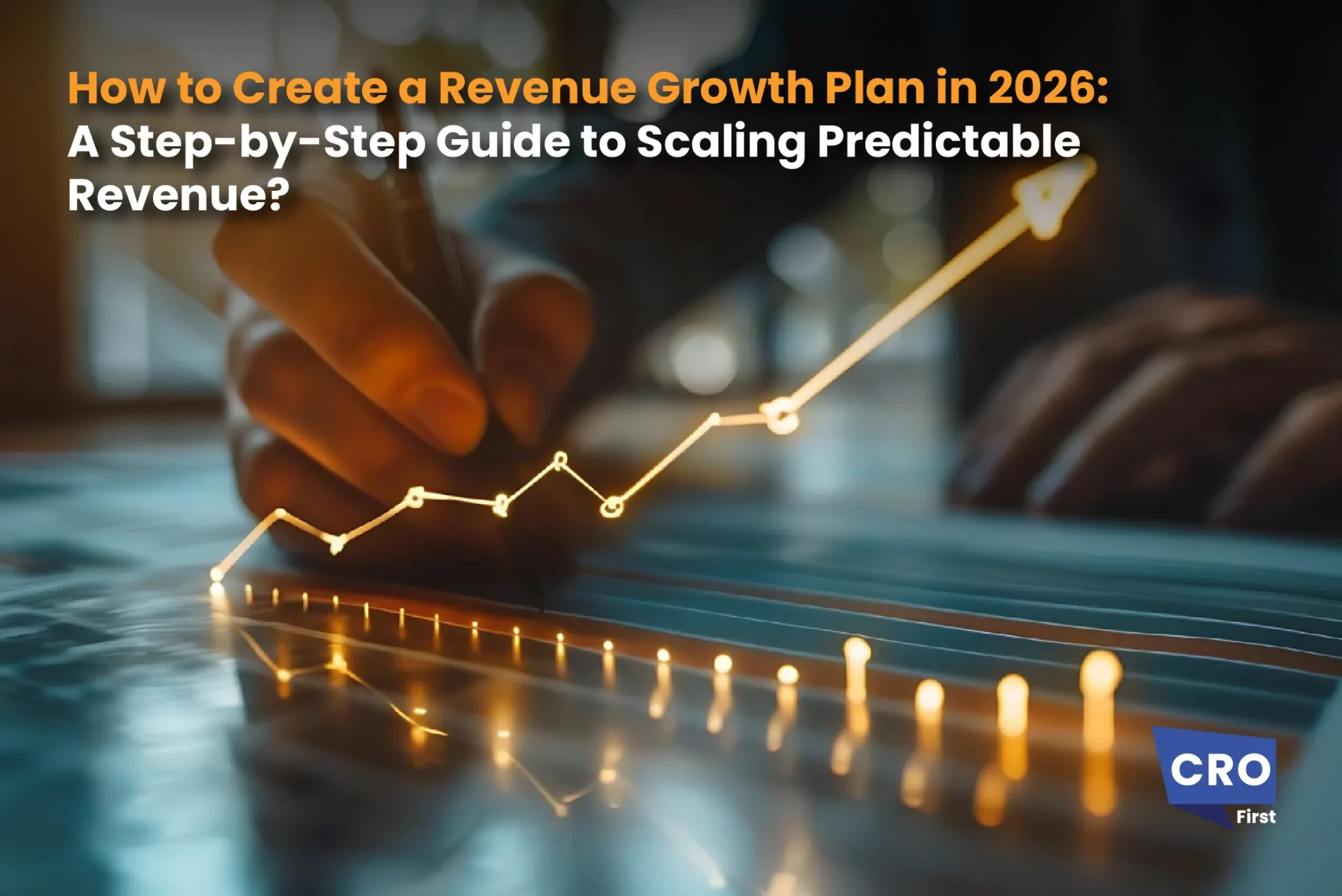
Growth is no more about churning out the biggest number you can get on the board. EY finds just 11% of those they’ve surveyed have sales, marketing and e-commerce working as a ‘unified growth engine.’
That gap matters because revenue rarely breaks in one department. It leaks between them. Knowing how to create a revenue growth plan means connecting five moving parts, sales and marketing, pricing, customer success, RevOps, and execution.
This guide shows how to create a revenue growth plan that turns those functions into one operating system instead of five separate agendas.
What Is a Revenue Growth Plan?

A revenue growth plan is a practical roadmap that shows how a business will acquire customers, monetize demand, retain accounts and expand revenue while keeping teams, data and processes aligned.
That makes it different from a generic business plan. A business plan usually explains where the company wants to go and how the broader business will operate. A revenue growth plan gets closer to the machinery. It connects customer acquisition with pricing, sales execution, retention and expansion.
Also Read:The Future of B2B Revenue Operations in 2026: How AI, Automation, and RevOps Are Reshaping Growth
Anyone learning how to create a revenue growth plan should first recognize that a company can have strong marketing, an active sales team and a good product, yet still struggle to grow predictably. Marketing may chase leads sales cannot convert. Sales may close deals customer success cannot expand. Finance may change pricing without enough customer insight.
The practical answer to how to create a revenue growth plan is to treat revenue as a shared system.
Step 1: Align Sales and Marketing for Pipeline Velocity
A stronger revenue growth plan gives sales and marketing shared responsibility for pipeline quality and movement. Instead of obsessing over MQL volume, agree on measures both teams can influence, such as pipeline generated, conversion rates, CAC and win rate. The conversation shifts from ‘How many leads did we generate?’ to ‘How much qualified revenue opportunity did we create?’
HubSpot’s 2026 State of Marketing found that 33% of marketing executives identify measuring ROI as a leading challenge. That is a useful warning. If marketing cannot connect its work to commercial outcomes, leadership will struggle to decide what deserves more investment.
Sales should tell marketing which accounts, messages and objections appear in real conversations. Marketing should feed those insights back into targeting and content. Both teams should review pipeline movement regularly.
Account-based revenue generation can sharpen this further. Identify the accounts that fit the business best and coordinate outreach around them. That is how to create a revenue growth plan that improves pipeline velocity rather than simply increasing lead volume.
Step 2: Optimize Pricing Strategy for Profitable Growth
Pricing is often treated like a finance decision that gets revisited when costs rise or a new financial year begins. That is a mistake.
A good revenue growth plan treats pricing as a living commercial lever. What problem does the product solve? How much value does the buyer receive? Which customers need the full offering, and which need a simpler entry point?
Value-based pricing can help answer those questions. So can smarter packaging. This is also central to how to create a revenue growth plan around profitable growth rather than revenue for its own sake. A lower-priced entry tier can reduce the barrier for new customers, while premium packages can capture more value from customers with deeper needs.
PwC’s current revenue-management work links pricing with revenue visibility, forecasting, optimization and predictability. That matters because pricing affects more than conversion. A complicated pricing model can create buyer friction and make future revenue harder to forecast.
The same logic applies to LTV. Make sure your pricing model supports the whole customer journey. Take into account how customers are behaving, their win/loss feedback and where they’re expanding.
If you see prices going down all the time to get a deal done, then it’s a sign to revise your revenue growth strategy rather than being celebrated by the sales team.
Step 3: Empower Customer Success to Drive Net Revenue Retention

Acquisition gets attention because new logos look like growth. Yet the customer base you already have can tell you far more about the quality of that growth.
Customer Success should move beyond a reactive support role. Its job is not only to solve problems after they appear. It should identify whether customers are adopting the product, reaching expected outcomes and finding reasons to deepen the relationship.
McKinsey’s analysis of 55 B2B SaaS companies found that top-quartile-valued companies achieved 113% NRR compared with 98% for bottom-quartile peers. The difference matters because NRR captures what happens inside the existing customer base through retention, expansion and contraction.
A practical revenue growth plan should turn that idea into a repeatable process. Start with customer health scores based on adoption, engagement, support patterns and business outcomes. Then map likely expansion paths.
Upselling should not feel like a sales ambush. It should follow demonstrated value.
NRR should sit in the leadership dashboard. A strong number suggests the existing base is holding and expanding revenue. A weak number demands investigation.
That is why NRR should be treated as a core indicator of sustainable growth, not as a standalone vanity metric.
Step 4: Centralize with RevOps as the Engine of Predictable Growth
Marketing may have one customer record. Sales may have another. Customer Success may work from a different view. This is where disconnected tools, duplicate data and manual handoffs start hurting the buyer experience.
RevOps exists to solve that problem. Salesforce defines this approach to aligning communication, systems and processes among all revenue impacting teams around common revenue goals. That includes not allowing sales, marketing, customer success and finance to operate as separate islands from each other.
Salesforce also found that 82% of high-performing organizations use the same CRM platform across service, sales and marketing. Revenue teams need connected information and consistent processes.
Start by auditing the GTM stack. Define which system owns each critical data point. Standardize pipeline stages and customer definitions. Then map the buyer journey and identify every point where information gets lost or work gets repeated.
This is where a revenue growth plan becomes operational. RevOps turns strategy into workflows, data and accountability. Without that layer, teams can agree on the plan and still execute five different versions of it.
Step 5: Execute and Measure Your Revenue Roadmap
A revenue growth plan should not sit in a presentation waiting for the next quarterly meeting. Turn it into a 90-day operating cycle.
The first 30 days should focus on diagnosis. Audit the funnel, pricing, customer health, pipeline, technology and current KPIs. Find bottlenecks before deciding what to fix. This is also where leaders should revisit how to create a revenue growth plan around actual constraints rather than an idealized target.
The next 30 days should focus on implementation. Set a small number of OKRs, assign owners and launch the highest-impact changes. That could mean changing qualification rules, testing a new package, creating an expansion play or fixing a RevOps workflow.
The final 30 days should focus on review and optimization. Compare results against the objectives and decide what should continue, stop or change.
Top 5 Revenue KPIs to Track in 2026
| KPI | What to measure |
| CAC | Cost required to acquire a customer |
| LTV | Revenue value expected across the customer relationship |
| NRR | Revenue retained and expanded from the existing customer base |
| Pipeline Velocity | How quickly qualified opportunities move through the pipeline |
| Win Rate | Share of qualified opportunities that become closed-won deals |
The point is not to build a dashboard packed with numbers. It is to create a small measurement system that tells leadership where growth is working and where it is leaking. A useful revenue growth plan makes those decisions visible early enough to act.
Conclusion and Next Steps
Predictable growth is not created by finding one brilliant acquisition channel or raising prices by a few points. Sales and marketing need a shared pipeline. Pricing needs to reflect value. Customer success needs to protect and expand the installed base. RevOps needs to connect the data and workflows. Execution needs a disciplined review cycle.
That is the real answer to how to create a revenue growth plan. Build one that exposes the gaps between functions, not one that simply gives every department a bigger target. The strongest plan is the one that makes ownership, trade-offs and revenue leaks impossible to ignore.
Start with an honest GTM alignment audit. Where does data break? Where do handoffs slow down? Which KPI does each team optimize? If those answers do not line up, the growth plan has already told you where to start.