
The most expensive part of a B2B funnel is often the part nobody owns.
Marketing generates the lead. The CRM marks it as an MQL. Then it moves toward Sales, where the excitement often disappears. The salesperson sees weak intent, the lead gets rejected, and Marketing rarely gets a useful explanation. The CRM quietly records another dead lead.
That gap between marketing qualification and sales acceptance is where pipeline efficiency starts to break down.
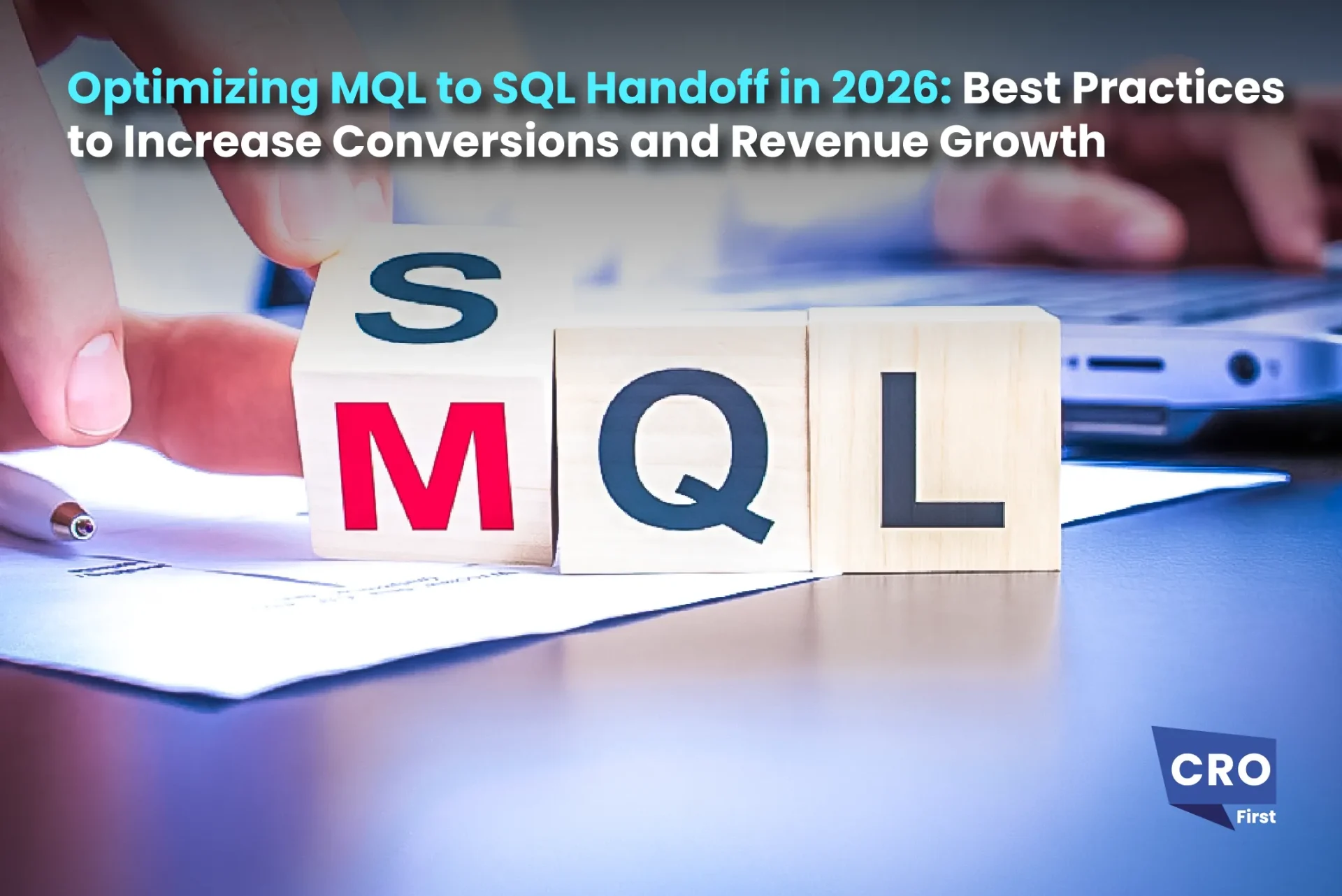
Optimizing MQL to SQL handoff is therefore not about passing leads faster. It is about agreeing on what a qualified lead actually means, identifying buying intent, routing the right prospects quickly, and learning from every rejection. This article breaks down where handoffs fail, what a healthy conversion process looks like in 2026, and how Sales, Marketing and RevOps can rebuild it.
Diagnosing the Broken Handoff and Why Leads Die

Most MQL-to-SQL problems do not begin with bad leads. They begin with different definitions of a good lead.
Marketing may see three content downloads, repeated website visits and webinar attendance as strong engagement. Sales may see the same activity and ask a much harder question. Is there a real business problem? Is there budget? Is someone actually evaluating a solution? Is there a timeline?
That definition mismatch creates the first leak.
Then comes the volume trap. When Marketing is measured heavily on MQL volume, the easiest way to look successful is to generate more MQLs. But more leads do not automatically mean more pipeline. In fact, a growing MQL count can hide a worsening handoff if Sales keeps rejecting the same low-fit prospects.
The third problem is the feedback void. Sales rejects a lead as ‘not qualified,’ but the CRM captures little more than that. Marketing sees the rejection but cannot tell whether the problem was company size, persona, timing, budget, geography or intent. So the scoring model stays unchanged and the cycle repeats.
This matters even more because LinkedIn and Bain’s 2026 research identifies buying groups as the unit of B2B decision-making. A single lead is often only one piece of a much larger commercial picture. Qualification needs to reflect that reality.
Also Read: Sales Enablement Tools in 2026: The Complete Guide to Boosting Sales Productivity and Revenue Growth
2026 Benchmarks and What a Good MQL to SQL Conversion Rate Looks Like

There is no universal MQL-to-SQL conversion rate that every B2B company should chase. That sounds unsatisfying, but it is more useful than a made-up industry average.
A high-velocity SaaS company can qualify leads around product engagement, firmographic fit and immediate buying signals. Enterprise sales are different. Longer cycles, multiple stakeholders and more complex buying journeys naturally change how qualification should work.
McKinsey’s 2026 Global B2B Pulse Survey found that buyers use an average of 10 channels across the purchasing journey. That makes individual lead activity a weak standalone measure of readiness in complex sales.
A useful real-world example comes from HubSpot’s MasterMover case study. The company achieved a 30% MQL-to-SQL conversion rate after addressing fragmented marketing and sales tools. That is not a universal benchmark. It is evidence that fixing the system around qualification can materially change conversion.
The better question is not ‘What percentage should we hit?’ It is ‘Are the leads Sales accepts consistently turning into meaningful pipeline?’
The 4-Step Playbook for Handoff Optimization
Step 1: Co-Create the SLA
The first step is uncomfortable because it forces Sales and Marketing to agree on something they often discuss separately.
Marketing should not decide qualification criteria alone, and sales should not change the definition every time the pipeline gets difficult. Both teams need to document the ICP, required firmographic criteria, acceptable personas, buying signals, disqualification rules and response expectations.
The SLA should also define what happens after the handoff. Who owns the lead? How quickly must Sales respond? What counts as acceptance? What qualifies as rejection? Which rejection reasons require recycling rather than disqualification?
The goal is not a long document that nobody reads. It is a shared operating rule.
A good SLA should make one thing clear. A lead becomes Sales-ready because it meets agreed business conditions, not because it crossed an arbitrary scoring threshold.
Step 2: Shift to Intent and Fit-Based Scoring
This is where many organizations need to rethink their scoring model.
A content download tells you that someone interacted with your brand. It does not necessarily tell you that the company has a problem, budget or urgency.
That does not make engagement useless. It simply means engagement should not carry more weight than commercial context.
Start with firmographic fit. Does the company match the ICP? Then look at role and buying relevance. Is this person close to the problem? After that, examine intent. Are there signals that suggest active research or evaluation?
Third-party intent data can add another layer, particularly in account-based motions. Instead of asking only whether John from Company X downloaded an ebook, ask whether Company X is showing multiple signs of active interest.
That shift changes the unit of qualification from an isolated person to a potential buying process.
Step 3: Enforce the Speed-to-Lead Rule
A good lead can lose value while sitting untouched in a CRM.
Adobe’s 2026 State of Marketing research found that more than 8 in 10 marketing teams missed an opportunity in the previous quarter because they could not respond in time.
That makes speed-to-lead a process issue, not simply a sales-performance issue.
Build automated routing rules around geography, account ownership, segment, product interest and salesperson availability. When a lead meets the agreed MQL criteria, it should reach the right owner without waiting for someone to manually check a queue.
However, speed should not mean sending generic emails within minutes.
The response needs context. The salesperson should know what triggered the handoff, what the prospect engaged with, which account they belong to and why the lead crossed the threshold.
Fast and irrelevant is still a bad experience.
Step 4: Make CRM Feedback Mandatory
The handoff cannot improve if rejection remains a dead end.
Salesforce reports that 51% of sales leaders with AI say disconnected systems are slowing their AI initiatives. It also reports that 74% of sales professionals are focusing on data cleansing, while high performers prioritize data hygiene at 79% compared with 54% among underperformers.
The lesson is straightforward. Your CRM cannot be treated as a storage cabinet. It needs to become a learning system.
When Sales rejects an MQL, make the reason mandatory.
| CRM field | What Sales should record |
| Rejection reason | Poor fit, wrong persona, no intent, timing, budget, duplicate |
| ICP fit | High, medium, low |
| Buying stage | Research, evaluation, decision |
| Timing | Now, 1–3 months, 3–6 months, unknown |
| Next action | Nurture, re-route, disqualify, follow up |
This creates a feedback loop between Sales and Marketing. Over time, the data can reveal which sources produce weak leads, which scoring rules create false positives and which signals consistently correlate with accepted opportunities.
That is where optimizing MQL to SQL handoff stops being a campaign exercise and becomes a RevOps discipline.
Upgrading the RevOps Tech Stack
Technology should support the process, not define it.
Lead routing platforms such as Lean Data can automate assignment and enforce routing logic. Intent platforms such as 6sense or ZoomInfo can add account-level signals that basic engagement scoring misses. Conversational AI can also help qualify inbound interest outside normal working hours and collect useful context before a salesperson gets involved.
However, the sequence matters.
First define the ICP. Then define qualification. Then define the SLA. Only after that should automation enter the picture.
Otherwise, the company simply automates confusion.
A sophisticated stack cannot compensate for Sales and Marketing using different definitions of ‘qualified.’ It can only move the disagreement through the system faster.
The Recycling Strategy for Rejected Leads
A rejected lead is not always a bad lead.
Sometimes the timing is wrong.
That distinction matters because a prospect with strong fit and weak timing is very different from a prospect with poor fit and no buying intent. Treating both as ‘Closed/Lost’ wastes information and future pipeline potential.
The recycling process should therefore start with the rejection reason.
If the issue is timing, move the lead into a targeted nurture track. The content should match the problem, industry and buying stage rather than dropping the prospect into a generic newsletter.
Then establish a future trigger. A new website visit, product interaction, account-level intent signal or meaningful engagement can push the lead back into scoring.
The important part is ownership. Marketing should own the nurture journey, while Sales should retain visibility into the account and the original rejection context.
A good recycling system does not chase every rejected lead forever. It separates not now from never.
Conclusion
The biggest mistake companies make with MQL-to-SQL handoffs is treating them as a routing problem.
They are not.
The real problem usually starts earlier, when Marketing and Sales agree on the word ‘qualified’ but mean completely different things by it. From there, bad scoring creates bad handoffs, weak feedback preserves bad scoring, and automation simply makes the cycle faster.
The answer is less glamorous than buying another tool. Define the ICP together. Score for fit and intent. Set a real response SLA. Make rejection data mandatory. Then automate what has already been agreed.
That is the real path to optimizing MQL to SQL handoff in 2026.
CTA Audit your last 100 rejected MQLs. If you cannot explain exactly why they were rejected, your handoff process is not optimized yet.